top of page
SPECIAL EDUCATION PORTFOLIO
(AUTISM SPECTRUM DISORDERS & HIGH INCIDENCE DISABILITIES)
EDUCATIONAL ADMINISTRATION PORTFOLIO
EDUCATIONAL ADMINISTRATION, SPECIAL EDUCATION, HIGH INCIDENCE DISABILITIES, AUTISM SPECTRUM DISORDERS, EMOTIONAL BEHAVIORAL DISORDERS, INTELLECTUAL DISABILITIES, RESOURCE SUPPORT & CURRICULUM DEVELOPMENT, BEHAVIOR INTERVENTION, GENERAL EDUCATION, AVIAN-ASSISTED INTERVENTION, APPLIED BEHAVIOR ANALYSIS, PROGRAM EVALUATION, EVIDENCE-BASED PRACTICES, ANIMAL ASSISTED THERAPY & INTERVENTION
Autism Spectrum Disorder Methods
M. Friedmann
The University of Kansas
Department of Special Education
May 1, 2023
Dr. Deborah Griswold, PhD (Teaching Professor)

Key Terms:
Structured Teaching:
"The article (Ganz, 2007), "Classroom structuring methods and strategies for children and youth with autism spectrum disorders," offers further insight into whether individuals with ASD respond favorably to information that is presented visually. This article provides a review of visually based strategies for organizing classrooms. Examples of structuring methods, visual schedules, and visually based organizational strategies are described and discussed. In addition, a brief review of the research literature, implementation guidelines, recommendations for effective use, and suggested resources for practitioners are provided" (University of Kansas, 2023).
Ganz; 2007
Visual Supports:
"Visual supports." Visual supports (VS), can help learners with ASD process information easier and more quickly in a variety of tasks and settings. This reading will help readers learn basic knowledge about visual supports (VS). Readers will also use VS in activity based scenarios that promote real-world application.
Autismspeaks.org. 2023
Nonaversive Treatment of Severe Behavior:
"Nonaversive behavior management is an approach to supporting people with undesirable behaviors that integrates technology and values. Although this approach has attracted numerous proponents, more adequate definition and empirical documentation are still needed. This article presents an introduction to the nonaversive approach. Important definitions are suggested, and three fundamental elements are presented: (a) an emerging set of procedures for supporting people with severe challenging behavior; (b) social validation criteria emphasizing personal dignity; and (c) a recommendation for prohibition or restriction of certain strategies. These elements are defined in hopes of stimulating further discussion and empirical analyses of positive behavioral support" (Horner, et.al, 1990).
Horner, et. al.; 1990
McKeithan; 2017
Augmentative and Alternative Communication:
"Expressive communication is one’s ability to communicate thoughts and feelings through words, gestures, or facial expressions. Augmentative and alternative communication provides alternate means of expressive communication when the learner has limited words or verbal communication to increase student communication, socialization, and engagement while reducing interfering behaviors" (Nowell et al., 2022).
AAC Brief Packet; 2022
Behavioral Communication:
"Although many caregivers and service providers may have some knowledge of the principles of ABA, sometimes those same people may perceive noncompliance or poor compliance as being more related to intentional, obstinate behavior and poor motivation rather than a form of communication. This is problematic because being able to communicate effectively is perhaps the most important of all life skills, and individuals with ASD have such severe deficits in communication, that they meet the criteria for ASD. Therefore, even though some individuals with ASD can sometimes communicate their thoughts and needs in some circumstances and conditions, we must remember that does not necessarily mean those same individuals can communicate basic wants and needs on demand and as needed" (University of Kansas, 2023).
Communication skills allow us to pass information to other learners, and to understand what is said(or communicated in other ways) to us directly and indirectly. Communication, at its simplest, is the act of transferring information from one place to another.
Communication forms:
-
vocally (using voice)
-
written (using printed or digital media such as books, magazines, websites or emails)
-
visually (using logos, maps, charts or graphs)
-
non-verbally (using body language, gestures and the tone and pitch of voice)
-
combination of several of these formats
.jpg)
Individuals with ASD are challenged by the most essential human behaviors. Learners with ASD may have difficulty interacting with other learners-often failing to see learners as learners rather than simply objects in their environment. Individuals with ASD may not be able to easily communicate ideas and feelings, have great trouble imagining what others think or feel, and in some cases spend their lives speechless. Making and keeping friends or even bonding with family members can be a significant challenge. Their behavior can seem bizarre.
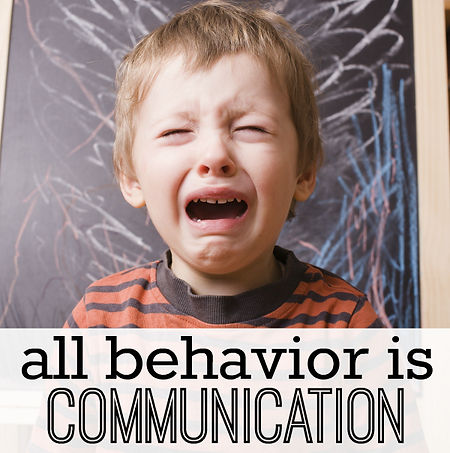
Behavior (or its absence when one is expected) may be interpreted as communicative if it has the intent to convey a message. Therefore, behavior is a form of communication. Humans communicate through behavior even if they are not aware of it. Behavioral Communication psychological construct which influences individual differences in the expression of feelings, needs, and thoughts as a substitute for more direct and open communication. Specifically, it refers to learners's tendency to express feelings, needs, and thoughts by means of indirect messages and behavioral impacts. In fact, much of human communication is non-verbal.
The main components of effective communication include:
-
The formation of communicative motivation or reason.
-
Message composition (further internal or technical elaboration on what exactly to express).
-
Message encoding (for example, into digital data, written text, speech, pictures, gestures and so on).
-
Transmission of the encoded message as a sequence of signals using a specific channel or medium.
-
Noise sources such as natural forces and in some cases human activity (both intentional and accidental) begin influencing the quality of signals propagating from the sender to one or more receivers.
-
Reception of signals and reassembling of the encoded message from a sequence of received signals.
-
Decoding of the reassembled encoded message.
-
Interpretation and making sense of the presumed original message.
The construct of behavioral communication can be conceived as a variable of individual differences. Often, individuals with ASD engage in indirect or behavioral communication (consciously or unconsciously) as an alternative to verbal communication.
(University of Kansas, 2023)
NIHCD, 2023
Discrete Trial Training:
Discrete trial training consists of an adult using adult-directed, massed trial instruction, reinforcers, and clear contingencies and repetition to teach a new skill or behavior.
DTT EBP Brief Packet; 2022
Naturalistic Intervention:
Grounded in behaviorism, naturalistic intervention (NI) consists of applying principles of applied behavior analysis during a learner’s everyday routines and activities in order to increase a target behavior or decrease an interfering behavior.
NI EBP Brief Packet; 2022
Social Skills Training and Interventions:
Social Skills Training refers to any adult-directed instruction in which social skills are targeted for improvement.
SST EBP Brief Packet; 2022
Structured Play Groups:
Structured Play Groups are small group activities with a defined area, activity, theme, and roles with typically developing peers and an adult scaffolding as needed to support the learner with ASD's performance.
SPG EBP Brief Packet; 2022
Naturalistic Intervention, Pivotal Response Training, and Response Interruption/Redirection:
"These hybrid approaches to ASD treatment combine elements of both applied behavior analysis (ABA) and developmental methods like Floor time" (University of Kansas, 2023).
"Relationship-based therapies persist despite an absence of research that supports effectiveness with individuals with ASD. This class of interventions is often considered an alternative to empirically validated treatments, so it is important to be aware of these strategies to better explain the evidence to caregivers and other key stakeholders in education" (Foxx & Mulick).
"Pivotal Response Training (PRT) is a contemporary naturalistic-behavioral intervention that applies principles of applied behavior analysis (ABA) to build on learner initiative and interests, enhancing the pivotal learning variables: motivation, responding to multiple cues, self-management, and self-initiations of social interactions" (Texas Education Agency, 2023).
"Response Interruption and Redirection (RIR) can be used to eliminate or reduce interfering behaviors. After reading this module, you will learn basic knowledge about modeling (RIR)" (AFIRM, 2023).
NI EBP Brief Packet; 2022
PRT EBP Brief Packet; 2022
RIR EBP Brief Packet; 2022
Video Modeling
"Video modeling is a mode of teaching that uses video recording and display equipment to provide a visual model of the targeted behavior or skill. Types of video modeling include basic video modeling, video self-modeling, point-of-view video modeling, and video prompting. Basic video modeling involves recording someone besides the learner engaging in the target behavior or skill (i.e., models). The video is then viewed by the learner at a later time. Video self-modeling is used to record the learner displaying the target skill or behavior and is reviewed later. Pointof-view video modeling is when the target behavior or skill is recorded from the perspective of the learner. Video prompting involves breaking the behavior skill into steps and recording each step with incorporated pauses during which the learner may attempt the step before viewing subsequent steps. Video prompting may be done with either the learner or someone else acting as a model" (Franzone & Collet-Klingenberg, 2008).
VM Brief Packet; 2022
Self-Management Strategies
Self-management techniques aim to teach students to regulate their own behaviour independently. Students learn to recognise an appropriate behaviour (as opposed to a behaviour of concern) such as putting their hand up to get teacher attention instead of calling out. They then learn to record the use of this appropriate behaviour independently. The aim is to help students develop independence in learning and behaviour and to decrease reliance on adult prompts. It has been used to help students monitor their social behaviour and to help them manage their own disruptive behaviours as well as to reduce stereotypical motor mannerisms. Teaching self-management skills generally involves identifying target behaviours that match the function of the behaviour of concern, identifying appropriate reinforcers for the student, teaching the student to recognise and record their use of the target behaviour, devising a system of recording the behaviour that is appropriate to the child and the setting and reviewing the plan.
Self-management is used in combination with other evidence based strategies such as social narratives, video modelling and visual supports.
(Brock, 2013)
SM EBP Brief Packet; 2022
bottom of page